
For background on how I think about Brookfield, see my original review here and my investor day preview here, which laid out how I reorganise Plan Value and what needs to happen for the stock to work.
This note is about Brookfield Corp (BN). It has 4 parts:
Conclusions, for those who want to keep it short.
Performance vs. past plans: 2021 investor day lookback.
2026 investor day takeaways.
Detailed investor day notes.
Future notes will cover the nature of Distributable Earnings, how BN is turning into an insurance company, and each of the major components of Plan Value.
Conclusions
BN has a habit of setting aggressive targets - and missing them. Specifically, they have a track record of overestimating growth, overvaluing assets for Plan Value (their sum of the parts), and vastly overestimating carried interest. They are 20-25% behind both the Plan Value per share and distributable earnings before realisations (DEBR) targets set for 2026 at the 2021 investor day.
That said, the absolute performance of both metrics is respectable - DEBR has compounded at 16% and plan value per share at 11% - and there are several reasons to believe the next 5 years might be better than the last:
BN’s earnings mix has shifted dramatically towards its faster-growing and more capital-efficient segments. 5 years ago, DEBR was roughly 40% asset management, 60% operating businesses and investments. Today the split is 75% asset management (BAM) and insurance (BWS), and 25% operating businesses and investments.
Asset management is accelerating, driven by a huge tailwind from the energy/AI investment boom and operating leverage.
Monetisations are accelerating - currently running at 3x the 2021 level - which gives BN a better chance of finally realising significant carry.
The natural lag in real estate cash flows might be turning in BN’s favour.
In addition to these operating factors, the valuation is better than it was in 2021. BAM and the listed affiliates are in today’s sum of the parts at lower valuations than they were in 2021. On top of that, BN trades at a bigger discount: 40% today vs. 20% in 2021.
Performance vs. past plans: 2021 investor day lookback.
This analysis is surprisingly difficult given the various splits, spins, movements of capital from one line to another, and presentational changes that BN have indulged in. What follows is roughly right, not perfect, but I think there is a fairly clear conclusion.
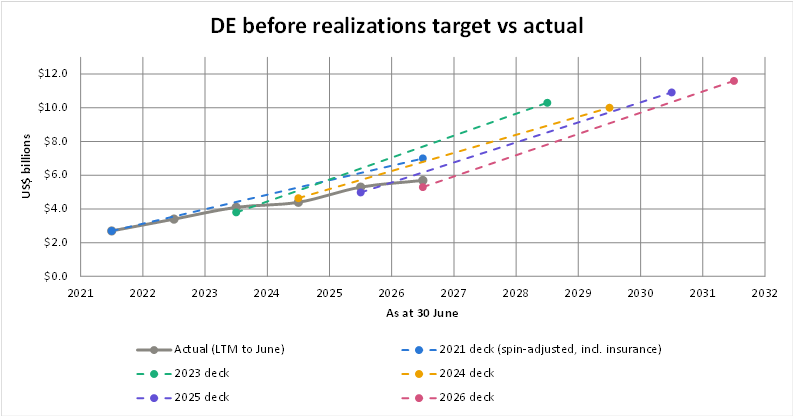
Let’s start with Distributable Earnings Before Realisations. After adjusting for the partial spin of BAM, DEBR has grown from $2.7bn in 2021 to $5.7bn in the 12 months to June 2026. That’s a 16% rate of compounding, so it is a respectable performance, and the target given in 2021 for 2026 was $5.6bn, so last week BN claimed to have met their guidance. However, the 2021 guidance excluded DEBR from BWS and free cash flow reinvested internally, while the 2026 actuals include both. Adjusting for this, I think BN actually missed their target by 20% of their target. By segment:
BAM missed very aggressive targets: 2026 fee-bearing capital was $672bn vs a target of $830bn. Some of the gap may be explained by an apparent change in which BWS assets are classified as fee-bearing, but there is a definite miss. Nonetheless, FBC compounded at 16%.
BWS came closest to meeting its goal but only because it was the beneficiary of significant capital allocation, both through retaining earnings and capital injections. We don’t know how much capital BN planned to put into BWS in 2021, and therefore whether BWS has actually met expectations.
DE from operating businesses has come in well below expectations, for at least 2 reasons. The first is that some holdings have been moved into BWS to support its growth, which is part of why it has met guidance. And the second is that Real Estate is generating essentially zero DEBR.
In addition to the DEBR miss, carry has been weak. According to the 2021 plan $7.9bn of net carry should have been realised over the last 5 years; in reality, $2.7bn has.
A quick look at the later investor day decks shows similar trends. BAM is compounding well but slower than planned, BWS is hitting targets but with the help of aggressive capital increases, and carry is a hockey-stick that keeps being pushed a year to the right.
Next, let’s look at Plan Value. At the 2021 investor day, BN’s Plan Value per share target for 2026 was $150-184. This needs a lot of adjusting. First, BN used a range because it valued asset management FRE at 25-40x. BAM now trades for 23x, so we will use the low end. Second, we need to adjust for the 3-for-2 share split, which brings $150 down to $100. Next, we need to adjust for the spin-out of BAM. On a split-adjusted basis, this reduces the Plan Value per share target by $11. (This isn’t perfect, because BN gets different carry economics on pre-spin and post-spin funds and the split is not disclosed - for these purposes, I have assumed 100% of 2021 carry value was retained and 25% of carry value expected to be created after 2021 was spun out.)
The adjusted 2026 target Plan Value per share is $89. The actual figure as of 2q26 was $67, for an 11% CAGR over the last 5 years and a 25% miss against the 2021 target. What drove the miss? Mainly:
Carry. Less realised carry meant less capital to redeploy and less DE from capital allocation. The same applies to less cash flow from real estate, but to a lesser extent.
Carrying value of listed affiliates. In 2021, BN assumed the share prices of BIP, BEP, and BBU would compound nicely. In fact, they’ve been flat to down.
Slower FRE and target carry growth than planned on the back of slower growth in fee bearing and carry eligible capital.
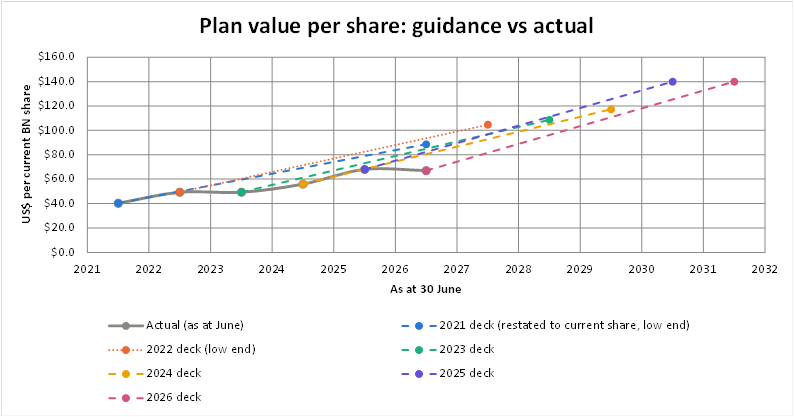
In short, Plan Value is growing at a reasonable clip but is well below target. A significant part but by no means all of the miss is due to factors outwith management’s direct control: the stock prices of BAM and the listed affiliates. The good news is that these are represented in 2026 plan value at significantly cheaper valuations than they were in 2021.
2026 investor day takeaways
As usual, BN are setting aggressive goals. They say DE can compound at 24% per annum through 2031. At the risk of mixing my farmyard metaphors, I’ll be as happy as a pig in the proverbial if this happens, but I’m not counting my chickens.
The 24% CAGR is made up of 17% in the core business (BAM, BWS, operating businesses, and investments), 3% from carry, and 4% from capital allocation. Note that this is total DE, not DEBR, but the difference between the two is not material today because not much carry is being generated; what is definitely material is whether the forecast is accurate.
History suggests that the carry and capital allocation goals, in particular, should be treated as upside optionality only. But BAM, the capital light asset manager, is clearly accelerating. And BWS, with a 4% average cost of liabilities, is a far more efficient way to fund investments than keeping them on BN’s balance sheet. The pending BN/BNT merger puts all of BN’s capital at the insurer’s disposal for growth; BWS is targeting $375bn of assets by 2031 and would be overcapitalised at $1tn of assets. BWS DEBR grows faster than assets as they reposition its portfolio. As discussed above, these two capital-advantaged and faster-growing assets have grown from 40% of DEBR in 2021 to 75% now. I think this gives BN a decent shot at growing DEBR in the mid-teens.
I’m also moderately bullish that significant carried interest will start to be realised. Carry is the major step from DEBR to DE. The target for the next 3 years is $5bn, down from $6bn a year ago despite negligible realisation in that time. Carry is paid on returns over a compounding hurdle. Two things kill carry. One is poor returns; the other is delayed exits. Interest rates rose sharply from 2021-2023, depressing asset valuations and complicating exits for several years. I doubt rates will rise as much over the next few years, so that headwind is dissipating. 60% of the $5bn 3-year target is expected to come from funds that have already returned all investor capital. That means that any further monetisations drive carry. Monetisations are already accelerating - currently running at 3x 2021 levels. In addition:
BAM have said they will realise carry earlier than expected on some funds launched since BAM was spun out from BN;
Bloomberg reports that Brookfield are analysing a $50bn IPO of Westinghouse, which alone would drive $800m of carry to BN (and a total potential gain of $7bn, as laid out in an excellent tweet here);
Perhaps most importantly, carry eligible capital is up from $144bn to $273bn over the last 5 years and is projected to double to $600bn over the next 5, giving BN many more shots on goal.
While none of these things guarantees the realisation of carry, I am cautiously optimistic about the combination.
DEBR from operating businesses has been falling for two reasons. One is optics: some of these investments are being moved into BWS as capital backing for insurance growth, so the earnings just show up in a different place. That’ll continue, juicing growth at BWS. But the other reason is real estate. BN has a large real estate operation on its own balance sheet. A big part of this (office) has suffered from a lag between interest rates (which rose sharply over the last few years) and rents (which rise over time, but only when leases expire, and they average 10 years). BN is starting to sign office leases at very large spreads over expiring leases. Assuming interest rates somewhat stabilise, as these leases come into force revenues should start rising faster than costs and cash flows from real estate should inflect upwards.
Finally, BN is converting from IFRS to US GAAP in 2027. This will be interesting. I think it might clean up some of the financial statements, since US GAAP will allow BN to carry investments in funds at NAV rather than consolidating them line by line. More importantly, the switch might enhance trust - in my experience US investors tend to think IFRS is a foreign conspiracy to defraud!
Detailed BN investor day notes
30-year DE CAGR 13%.
“We are in the very early innings of an investment cycle in technology, energy, industrials and real assets” that has 15 years to run.
BN can grow Distributable Earnings 24% per year to $16.8bn in 2031:
Over the last 5 years they grew total DEBR at 16% from $2.7bn to $5.7bn (LTM actual), despite rising rates.
Core DEBR will grow at 17% from $5.3bn (30.6.26 annualised run rate) to $11.6bn. Within this:
BAM grows FBC and DEBR before debt costs at 18%.
BWS grows to $375bn of assets and compounds DEBR at 23% with a 15% ROE.
DEBR from Direct Investments, Operating Businesses, and Other falls from $1.4bn to $1bn as BN’s balance sheet investments shift over to BWS, the insurance company. In the process, Direct Investments releases $6bn of cash for BN to reinvest.
Carry adds another 3% to the DE CAGR
“Last year, we said that we felt carried interest was approaching an inflection point, and we absolutely believe that to be the case.” Monetisations have tripled over the last 5 years and the exit pipeline continues to grow.
Over the last 10 years they have realised $4bn of carry.
Over the next 10 they expect to realise $25bn:
Years 1-3 $5bn, 60% of which is from funds that have already returned 100% of investor capital, implying they just need to deliver the preferred return to start generating carry.
Years 4-5 $6bn.
Years 6-10 $14bn.
On funds launched before the BAM spin-out, BN earns 100% of the carry and pays 100% of the costs. On funds launched after the spin, it earns 33% of the carry with no cost. Carry may be unpredictable but this is a capital-light, fast-growing royalty: carry eligible capital has nearly doubled over the last 5 years to $273bn and they target $600bn in 5 years.
Capital allocation adds another 4% to the DE CAGR.
$54bn of FCF over the next 5 years, of which 75% is from asset management and BWS. This does not appear to include $16bn of net but nonrecurring realisations planned from Direct Investments and Real Estate, so the total capital available may be closer to $70bn.
Of this, BN will reinvest c.$24bn to grow existing businesses if the returns justify it, and spend $4bn on dividends.
That leaves $26bn of FCF and $16bn of realisations to be allocated.
“Our view is there is a fourth business out there [that has to] earn a high return on capital [and] be distinctly helpful to the other businesses” (being asset management, wealth solutions, and operating). “We’ll be patient. We’ll find the right one. It will have to be highly additive.”
“Growth for the sake of growth does not matter. Growth for the sake of franchise building and profitability matters a lot.”
That takes plan value per share from $67 today to $140 in 2031.
BWS
Now generating $2bn of DE and $3.5bn of capital every year. I believe the difference is unrealised capital gains.
Each of their insurers is rated A by a number of agencies.
The average cost of funds is 4%.
The balance sheet is half cash & liquid assets, half BAM funds.
Have kept the liquid assets short; starting to lengthen duration as rates rise.
In the first part of the decade private credit spreads were fat so they concentrated fund investments there.
As spreads have tightened they have moved more to the equity funds. 20% of total assets is now in equity strategies.
Since 2020 credit spreads have tightened 300bps and annuity rates have risen 200bps; most peers saw spreads compress but Brookfield delivered consistent 180-220bps spreads from 2022-2026.
5 year targets:
$375bn of assets, organically.
DE to $5.8bn.
Plan value per BN share to $29-37 at 12-15x.
Opportunistic M&A additional but not necessary.
Longer term, the growth potential is enormous.
The BAM spin and 5 years spent building the insureco have massively BN’s expanded access to capital.
After the pending merger of BN and BNT, BWS can absorb BN’s investment assets with a more efficient capital structure. In effect BN will have a permanent capital base of $175bn and insurance float of $170bn for a total capital base of $345bn. “That will allow us if we choose… to grow our insurance book to $1 trillion and be way overcapitalized.”
“The pairing of our permanent capital with our insurance float, we believe, gives us the capacity to sustain [historical] returns on equity…for the next 20, 30, 40, 50 years. It is a very powerful structure.”
Real Estate
L5Y super core same-store NOI CAGR 4%. Next 5 year target also 4%. The difference is interest rates won’t rise as much so operating income growth will convert to cash flow growth.
“Today, we have pricing power in our real estate business. We are now in a market where there is a chronic shortage of supply of the highest quality real estate. There is an excess of demand and the movement in rents that we’re able to achieve is significantly greater than any impact that interest rates would have. So the real estate business is now moving from improving fundamentals to converting that into improving cash flows.”
Excluding real estate funds within Direct Investments, BN’s real estate exposure consists of:
$20bn supercore (10/10 retail/office);
$9bn core (6/3);
$4bn value add (substantially all retail);
$3bn resi;
less $8bn of debt and prefs at the real estate operation.
The $20bn in Supercore is gross equity after deducting property level debt at a low 46% LTV, and consists of:
$8.3bn in 10 office complexes with LTVs of 52%. These have a weighted average lease term of 10 years, which is why rent increases take time to flow through to cash flow. But “we’ve seen office construction really fall off of a cliff and future supply is really nonexistent” and it will be years before that changes. Leasing spreads are strong - e.g. Manhattan West is signing leases at 100-120% spreads over the 10 year old leases that are expiring.
$9.4bn in 18 “fortress” retail assets with LTVs of 37%, virtually fully occupied with high productivity tenants. “It is virtually impossible to recreate [a big shopping center] where 20 million people, 30 million people [walk through every year]”. Retail demand is strong while supply growth has collapsed: in the US, offline retail sales are up >30% since 2019 while retail construction completions are down from 55-60 million square feet per year in 2019 to 12msf now. Leases include percentages of sales which drive annual uplifts averaging 3%, so re-leasing spreads aren’t as big as in office, but recycling to higher quality tenants does drive positive leasing spreads.
$2bn in mixed use with urban retail, luxury resi, and hotels.
BN targets $10bn of asset sales from Core and especially Value Add over the next 5 years. Liquidity is returning: US market financings and transactions are up 25-30% y/y.
Although rates are rising, credit spreads are tightening, especially in retail - just refi’d a supercore retail asset at a 109bp spread, close to historic tights.
Switch to US GAAP in 1q27
Enhances comparability with US peers.
Will be able to show investments in funds (direct or through listed affiliates) at NAV, not consolidated line by line. Impacts all 3 statements.
Unrealised carry, which does not appear on IFRS statements, is recognised under US GAAP.
On AI: “we, as an industry, can’t build enough. We can’t even build a fraction of what everyone thinks they need…I don’t know if they actually needed all of it, but it’s not happening.”
Venture. BN has $2.8bn in SpaceX, Figure, Anthropic, hark, The Boring Company, etc.
All of that might add up to a very nice prospective return.Thanks for reading - if you enjoyed reading this please like and restack, and do get in touch if you have questions.
Pete
Disclaimer: This post is for informational and educational purposes only. Building Arks is not licensed or regulated to provide any financial advisory service and nothing published by Building Arks should be taken as a recommendation to buy or sell securities, relied upon as financial advice, or treated as individual investment advice designed to meet your personal financial needs. You are advised to discuss your personal investment needs and options with qualified financial advisers. Building Arks uses information sources believed to be reliable, but does not guarantee the accuracy of the information in this post. The opinions expressed in this post are those of the publisher and are subject to change without notice. The publisher may or may not hold positions in the securities discussed in this post and may purchase or sell such positions without notice.