
Brookfield (BN) has its investor day on Thursday. This will be interesting, because the company’s preferred measure of earnings - distributable earnings, or DE - has grown significantly slower than expected recently. For example at the September 2025 Investor Day BN said they thought they could grow DE per share at 25% through 2030, but LTM growth has only been 6%. Granted some of DE is lumpy, making one-year measures less meaningful, but it is clear that either BN is not going to meet its guidance, or the next 4 years are going to be spectacular.
I have owned Brookfield almost continuously for 18 years, and in size for 8. My original review is here. I think the company has a slew of competitive advantages and some very attractive tailwinds for growth. I also think it is well managed by aligned people. I’m fairly settled on its being a permanent holding so long as the price is reasonable. Therefore, I don’t deep dive into every quarterly report.
However every now and again I do review it thoroughly, and over the next few months I hope to review each part of the empire. This is the first of those articles. It reframes BN’s Plan Value to help us understand what needs to happen for the stock to work.
Plan Value
BN’s Plan Value is a sum of the parts. I like it because it’s easy to understand, the methodology is broadly sensible, and it feeds into management incentives.
The company’s goal is to grow Plan Value by 15% plus per year. The stock trades at a substantial discount to Plan Value, so if they achieve their goal it will be a very good investment.
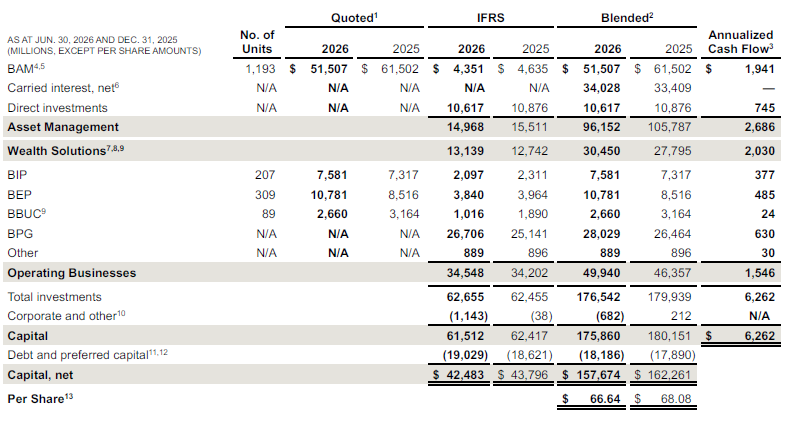
Plan Value is published in the quarterly supplemental and looks like this:
Of these:
BAM, BIP, BEP, and BBUC - the asset management, infrastructure, energy, and private equity companies, respectively - are separately quoted and are carried at market.
Carried interest is the present value of the future carry that BN expects to earn on funds managed by BAM. It is calculated as unrealised carry + 10x target carry, where target carry is what BN would earn if each fund met its investment targets.
Direct investments are investments that BN makes into funds managed by BAM, both to capture investment returns and to help BAM seed new funds.
Wealth Solutions (aka BWS) is an insurance company selling annuities, pension risk transfer, etc. BN value it at 15x distributable earnings, which comes out at about 2.3x IFRS book value.
Finally BPG is Brookfield Property Group, BN’s large on-balance sheet real estate operation which mainly owns offices and malls.
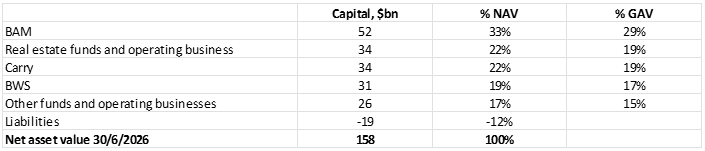
Restated Plan Value
I restate Plan Value in two ways. First, I group BPG with the real estate direct investments to show total exposure to that sector. And second, I group the remaining direct investments and operating businesses into one line representing BN’s infrastructure, energy, and private equity holdings, which are individually fairly small.
I think this gives a clearer idea of where BN’s capital is actually allocated as of June 30, 2026:
One way to think about the discount
Whichever way you split Plan Value, it’s clear BN stock trades at a fat discount. On June 30th the discount was 35%: Plan Value per share was $66 but the share price was $42.5. Does this make sense?
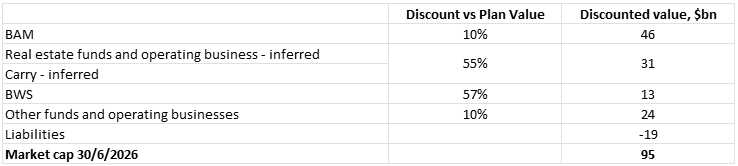
All of BAM and the majority of “other funds and operating businesses” are listed. Perhaps these assets deserve a conglomerate discount, but not a big one (especially considering BN has control). I assume 10%.
However, Real Estate, Carry, and BWS are all unlisted. It seems clear that the market doubts the value of these segments. This is significant, because they account for 55% of gross asset value.
If we value BWS at its IFRS book value of $13bn, not the 15x DE that Brookfield thinks it is worth, we can infer how much the market is paying for real estate and carry. The answer is that as of June 30th, all three assets were discounted by about 55%:
But why?
It’s not hard to understand why the market discounts these assets:
In real estate, the market still doubts the IFRS carrying value of office and mall assets in the face of work-from-home and online stopping trends. In addition, there is a lag built into the real estate P&L: during a period of rising inflation, interest rates (costs) rise first and rents (revenue) rise later as leases renew. BN’s real estate is not generating much cash as a result.
On carry, the market has virtually no visibility. At the 2025 investor day, BN said they would realise $25bn of carry over 10 years and $6bn in 3; yet in the first year of that forecast, they only realised $0.5bn. What should we believe?
BWS is a relatively new asset at Brookfield (they started building it in 2020) and hasn’t been seasoned through cycles. In addition, while 15x DE may make sense in theory (it’s a 7% earnings yield; add inflation and you get +/- a 10% total return assuming capital can’t be reinvested at attractive returns, which it probably can) it’s a unusual valuation methodology for an insurance company. A market that can’t really be bothered with conglomerates isn’t going to look much further than book value to value an insurance company inside a conglomerate.
So what needs to happen for the stock to work?
First and most obvious: Plan Value needs to keep growing, ideally at or around BN’s 15% goal.
Second, for the discount to close, we need to see:
Rising cash flows out of real estate as new rents, signed at significant spreads over current rents, kick in.
Significant sales of real estate assets at or near IFRS carrying value, both in the funds and in BPG.
Substantial cash generation from carry.
Continued growth at BWS, ideally with a strong organic component, and additional disclosures to convince the market that it is worth more than 1x book value.
I think there is a decent chance that all of these things will happen, at least to some extent. If they do, the stock will perform strongly from the current price. I’ll explore all of them in future articles over the next few months.
But first, let’s see what management has to say at the Investor Day. I think they will have a lot to say on these topics.
Thanks for reading - if you enjoyed reading this please like and restack, and do get in touch if you have questions.
Pete
Disclaimer: This post is for informational and educational purposes only. Building Arks is not licensed or regulated to provide any financial advisory service and nothing published by Building Arks should be taken as a recommendation to buy or sell securities, relied upon as financial advice, or treated as individual investment advice designed to meet your personal financial needs. You are advised to discuss your personal investment needs and options with qualified financial advisers. Building Arks uses information sources believed to be reliable, but does not guarantee the accuracy of the information in this post. The opinions expressed in this post are those of the publisher and are subject to change without notice. The publisher may or may not hold positions in the securities discussed in this post and may purchase or sell such positions without notice.
Just recently came across your writings, really enjoyed it. Looking forward to Thursday !