

Summary
What it does: Brookfield is a leading global alternatives/private asset manager.
Elevator pitch: Brookfield is a phenomenal franchise with deep moats in a growing industry. The company has great management, the stock has delivered 19% CAGR for 30 years, and there are multi-decade tailwinds in private asset creation - yet the stock is cheap both on an asset basis and on future cash flows.
Mental model: moat, value.
Valuation and potential returns: trading at 6.5x target 2030 distributable earnings. I expect the stock to compound at 15-20%.
Exchange: NYSE, TSX.
Stock price and market cap: $45, $101bn.
Type of holding: I own this in my capital allocator bucket. I intend to own it permanently unless it becomes obviously overvalued. It is 12% of my portfolio.
Disclaimer: This post is for informational and educational purposes only. Building Arks is not licensed or regulated to provide any financial advisory service and nothing published by Building Arks should be taken as a recommendation to buy or sell securities, relied upon as financial advice, or treated as individual investment advice designed to meet your personal financial needs. You are advised to discuss your personal investment needs and options with qualified financial advisers. Building Arks uses information sources believed to be reliable, but does not guarantee the accuracy of the information in this post. The opinions expressed in this post are those of the publisher and are subject to change without notice. The publisher may or may not hold positions in the securities discussed in this post and may purchase or sell such positions without notice.
Introduction
I have owned Brookfield almost continuously since 2008 and in size since 2018. Over that time I have developed confidence in certain aspects of the company that don’t always get attention. This note discusses some of those. It is not a primer - others have written excellent primers, some of which are linked below.
I use the term “Brookfield” to refer to the whole organism; when I want to reference a specific entity, I use the ticker. I own BN.
Slide snapshots are from the BN 2025 investor day deck.
Quick overview and further reading
Brookfield Corporation (BN) owns a controlling stake in Brookfield Asset Management (BAM). BN also invests its balance sheet capital into investments sourced by BAM. BAM is one of the world’s leading private asset managers. It invests client money into a diverse array of assets for a fee. These assets broadly form “the backbone of the global economy” - real estate, energy generation and transmission, data infrastructure, transport, logistics, and much more. For more on what Brookfield is and does, here are a couple of good recent pieces:
Rock and Turner’s 3-part analysis of the alternatives industry and major players (part 3 is on Brookfield).
Rijnberk’s Brookfield review.
Why private asset managers exist
They always have - we just used to call them investment banks. The economy needs capital to invest in innovation and asset creation. But traditional investment banking proved to be dangerous. Investing depositor money on a fractional reserve levered basis into on-balance-sheet risky investments carried a real risk of contagion and deflationary collapse. Over time many of these activities were regulated away from banks, with the last big bout of regulation coming after the GFC. This created the conditions for alternatives managers to thrive. Instead of issuing deposits, creating money via fractional reserve banking, and owning assets on their own balance sheets, private asset managers raise equity and debt capital from investors and own the assets in fund structures. The investors understand the risks they are taking better than depositors do, fractional reserve banking is at least somewhat removed from the equation, leverage is lowered, and the risk of contagion is much reduced. And it just so happens that managing private assets this way is an excellent business.
Fee pressure in private assets
Asset management businesses are scalable, asset light, and cash generative. However, managers of public assets have been subject to huge fee pressure for many years as a result of competition from low cost index funds. This has pressured manager economics and arguably made the industry worse for investors: with lower fees, the only way to make the business work is to take on more assets, which rarely helps performance.
If assets don’t trade on public exchanges, there’s no way to create an index or a low-fee index fund. This shields managers of private assets from excessive fee pressure. There is still competition, because there are several good private asset managers and many wannabes, but there is no race to the bottom. There are two things that I think are absolutely key to any investment in Brookfield. This is the first of them.
TAM 1: long term growth in private assets
Arguably, and if done well, holding assets privately is a win-win-win:
It’s better for the manager, who earns a higher fee.
It’s better for the investor, who doesn’t suffer public market volatility.
It’s better for the underlying asset, which gets patient capital.
This is not a consensus view. Consensus has it that the average manager can’t outperform and so fee reduction is the name of the game. Some also argue that public markets are better for investors, because they offer immediate liquidity and more transparent pricing. But most investors don’t need immediate liquidity - their time horizon is measured in decades - and unfortunately public markets are highly volatile and humans are emotional. Investors often underperform their public market investments because they buy high and sell low. Peter Lynch’s Magellan Fund compounded at 29% from 1977 to 1990, yet the average investor in the fund lost money. I think illiquidity is actually an advantage for most investors, even at the cost of a slightly higher fee.
If I am right, and all participants have an incentive to take more assets private over time, then Brookfield’s TAM will keep growing.
TAM 2: life insurers’ desperate need for long term assets
Over the last 5 years Brookfield has built a significant insurance business. This primarily sells life insurance and retirement annuities - to grossly oversimplify, retirees in effect lend money to Brookfield in return for fixed payments. Brookfield then invest the money, and pocket the spread between the cost of funding and the return on assets. Aging and the growing need for retirement income are common knowledge amongst investors. What is perhaps less obvious is how hard it is to find appropriate income-generating assets in a world with structurally low real interest rates. Being able to source appropriate investments is a huge competitive advantage for any seller of retirement products. The kinds of assets Brookfield buys, builds, and operates are perfect, and I think they will build a huge business here over time.

Scale as an advantage rather than a disadvantage
In public asset management, scale is usually seen as a disadvantage. There are only so many mis-pricings, and the bigger you are, the harder it is to get meaningful exposure to them within a reasonably diversified portfolio.
I think the opposite is true for private asset managers. Private asset managers buy control, not slivers of equity. Control requires big cheques. And as a rule, bigger businesses are higher quality businesses - more established, with greater cash flows and deeper moats. To buy control in a big business requires a really big cheque, so paradoxically there is less competition for the biggest and best assets. Also, the bigger you are as a private asset manager, the better your relationships with investors and capital providers - and access to finance is the name of the game.
Diversification and internal competition for capital
I like the fact that Brookfield is internally diversified, for three reasons.
First, I can concentrate my capital on the risk I want to take (Brookfield’s fundraising and investment sourcing franchise, and their culture and management skill) and still not be over-exposed to any one underlying asset class, country, or sector.
Second, internal diversification means there is significant competition for Brookfield’s own capital. Consensus has it that conglomerates are bad because they lack focus and are inefficient, and that’s a fair criticism of many. But as a manager of third party capital Brookfield is highly incentivised to optimise financial outcomes and move on to the next investment, and in cases like that I think internal competition for capital is a very good thing. Contrast that with “compounder bro” thinking, where the focus is on finding a business that does one thing extremely well with deep competitive moats. Get that kind of investing right and you’ll do very well. But those businesses can usually only invest their capital in one place. That is a recipe for disaster if the moat turns out to be more of a ditch - especially if the “investment” was in the form of buybacks at elevated compounder multiples.
Third, internal diversification makes it easier for the company to adapt and stay relevant. 50% of what Brookfield invest in today didn’t exist as widely-held institutional asset classes 15 years ago. I suspect the same will be true in another 15 years, as vast new institutional asset classes come into being (AV fleets? Humanoid robots? Datacentres in space?). This adaptability arguably gives Brookfield a better chance of thriving in the long term than any other potential moat could do.

(Almost) all economic conditions are good
Brookfield is exceptionally well-structured to benefit from cycles.
This is partly because it mostly invests in assets with stable cash flows. In many cases, these cash flows are actually contracted; in others, the stability comes from things like large aftermarket revenue streams or in the case of asset management from the fact that most of the assets are locked up in multiyear funds and can’t be redeemed on demand. Revenues are also largely inflation linked - again in some cases this is explicitly contracted, in others it is implicit but effective.
More importantly, because Brookfield is both a buyer and a seller, one or other of Brookfield’s activities can thrive in each part of the cycle. Growth is strong, liquidity is abundant, and markets are euphoric? Sell assets and reap carry. The opposite? Raise money, buy assets, and collect fees while you wait. Inflation and rates are rising? Sit tight and watch your revenues go up with inflation. The opposite? Refinance and up-finance assets to reduce interest costs and free up cash to return to investors or buy new assets. The key to long term returns is not interrupting compounding, and when the world falls apart, what stops me selling Brookfield is the knowledge that they are raising and deploying capital at phenomenal returns.
For example, during covid, markets panicked about the future of office and retail real estate. Brookfield doubled down and bought out the minorities in Brookfield Property Partners (BPY) in 2021. Then inflation and interest rates rose, wiping out profits at BPY and depressing real estate valuations further. But Brookfield saw that high inflation would eventually lead to rent growth and new construction starts had stalled, creating a supply vacuum for a few years’ time. Brookfield went marketing and raised around $35bn into two new vintages of their flagship Real Estate Opportunities fund, BSREP IV and V, which closed in 2022 and 2025. Today, rental growth is strong, leverage is positive, liquidity is returning, and rates seem headed down, with asset prices likely to rise “substantially” (BN 4q25 letter).

Today, there are concerns in the market about private credit. There are likely bad credits in commoditised parts of the market, and credits exposed to software may be exposed to AI disruption. Brookfield has a large private credit franchise, which mostly specialises in asset-backed lending with little software exposure. But they also have Oaktree’s famous Credit Opportunities Fund, which goes hunting when there is blood in the water. This makes Oaktree a counter-cyclical business: it struggles to raise money and invest in the good times, but it cleans up in the bad times. Brookfield commented on their 4q25 call that troubles in private credit had increased activity at Credit Opportunities in the last couple of months. Let’s see how that pans out.
Debt structure
Brookfield is highly levered. But usually debt structure matters more than debt quantum, and Brookfield’s debt is exceptionally well-structured.
At the corporate level, BN and BAM are relatively lightly levered and most of the debt is long, low, and fixed: exactly what you want to juice equity compounding without much risk.
The vast majority of Brookfield’s debt is at the asset level, using debt that suits the asset - e.g. where a hydro power plant has a 20-year PPA, Brookfield will typically borrow amortising 20-year debt against that PPA, effectively securitising the PPA payments to generate immediate cash for reinvestment. Crucially, the asset-level debt is ringfenced: it is non-recourse to the company and it is not cross-collateralised against other assets. This means problems in one asset can’t infect others. This is the second thing that I think is absolutely key to any investment in Brookfield.
Finally, Brookfield structures some of its debt to create options. A great example is the debt within BPY when Brookfield took it private. At a headline level, BPY was highly levered. However the portfolio comprised two parts: core prime real estate that Brookfield intended to own forever, and redevelopment/turnaround assets intended for eventual sale. The core assets were levered around 50%, while the noncore assets were much more levered. I love this: the significant majority of BPY equity was in the best assets, relatively lowly levered, and carried low risk. The thin sliver of equity in the noncore assets was at great risk, but there wasn’t much of it and it was nonrecourse to the other assets. This meant that most of the risk in the noncore assets was borne by the lenders, but if Brookfield could engineer a turnaround at any of those assets, it stood to make a lot of money. The headline leverage looked scary, but in fact BPY owned a low risk core business and a quiver of free options.
Levered inflation protection
The combination of inflation linked assets carrying appropriately structured debt means that Brookfield offers levered exposure to inflation. We live in a fiat world in which governments can’t resist printing money, especially in crises. That creates inflation. The first goal of any investment strategy has to be to preserve purchasing power. If your revenues grow with inflation, and you lever appropriately, your profits should grow a little faster than inflation. That alone is investing gold.
Brookfield as its own banker
While Brookfield doesn’t cross-collateralise its debt, BN does have a huge balance sheet which it can use to support subsidiaries when they need it. This mechanism is used relatively sparingly, but it is very valuable: for example, if an affiliate wants to complete an acquisition but financing conditions aren’t great, BN can lend bridge financing until the affiliate can issue debt on good terms. This adds an important degree of flexibility to Brookfield.
Consistent messaging/strategy
One of the things you notice when you own a stock for nearly 20 years is how much the “story” changes. I love it when stories don’t change. When management describes their business the same way year in, year out, I think it tells you something quite important about the durability of the business. I find it remarkable how consistent Brookfield’s messaging has been as they have methodically built out their franchise. That doesn’t mean that everything they have talked about has worked out - that would be freakish. But the messaging about key things has been very stable: how they think, what their strategic direction is, what kinds of assets they like, why demand for these assets is growing, what returns they target, how they achieve those returns, why investors like Brookfield, how they build their culture, how they handle succession, etc. And at a high level, they have absolutely achieved what they set out to achieve 20 and 30 years ago. I think this is a phenomenally well-managed business.

Alignment
Senior management hold much of their net worth in Partners Value Investments, which in turn owns BN, BAM, and other Brookfield entities. Partners is separately listed (PVF.UN on the TSX) and importantly it is levered. In most companies, managers get paid in stock options. This gives them an incentive to swing for the fences: if it works they make out like a bandit, and if not they lose nothing. PVF arguably achieves the opposite: because it is levered, the senior managers at Brookfield will lose everything before minority shareholders do. They have a strong incentive to grow carefully and methodically while protecting the downside.
Second, the company is aligned with its clients. Both BN and BAM invest into funds managed by BAM. If I was a client, this would give me confidence, and I think it is an advantage over less well-capitalised firms. It also allows Brookfield to seed new funds to broaden their business.
Third party due diligence
Brookfield is a relatively difficult business to analyse. It owns consolidated, associate, and minority stakes in a huge variety of assets, which it buys and sells regularly. This makes for complicated financial reporting and lumpy earnings. Brookfield disclose a huge amount of information and in my view do a good job of helping investors understand what really matters, but a degree of trust is needed.
One thing that helps me build trust in Brookfield is 3rd party due diligence. Brookfield has relationships with 2,500 institutions who invest in their funds and coinvest directly in some of their investments. Some of these institutions will be relatively small and have limited capacity for due diligence. But some are monsters - huge professional organisations with deep capabilities that do extensive research and choose their partners carefully. The fact that they are willing to back Brookfield, and reinvest again and again in its funds and sometimes directly in the underlying assets, is telling.
Added to this is the fact that Howard Marks and Bruce Karsch chose to sell their life’s work to Brookfield. These men - and the people who work for them at Oaktree - are exceptional analysts and investors. Their choice to partner permanently with Brookfield - and to oversubscribe for shares rather than cash in the original transaction - is a useful indicator.
The fundraising and asset sourcing machine
Finally, Brookfield has transformed itself over the last 30, 20, and 10 years. 30 years ago it was an owner and operator of assets recovering from a major crisis (long story short: this is how Brookfield learned not to cross-collateralise its debt). 20 years ago it was well on the path to being a manager of 3rd party capital with its operating expertise as the backbone, but it was subscale. 10 years ago it had relationships with 250 institutional investors and was in the market with 4 strategies. Today it has relationships with 2,500 institutional investors and in 2026 it will raise money across 60 strategies. In addition it has 70,000 private wealth clients and 800,000 insurance policyholders, and all these numbers are growing. Across multiple asset classes it offers flagship funds, evergreen supercore and core funds, credit funds, geographical sleeves, co-investment opportunities, etc., meaning it offers something to suit the return, risk, duration, and diversification requirements of almost any investor. As they said on the last call, they “have built a business that can raise capital more consistently and deliver an earnings profile that is more predictable, more resilient, and better positioned to grow across economic cycles”.
End note
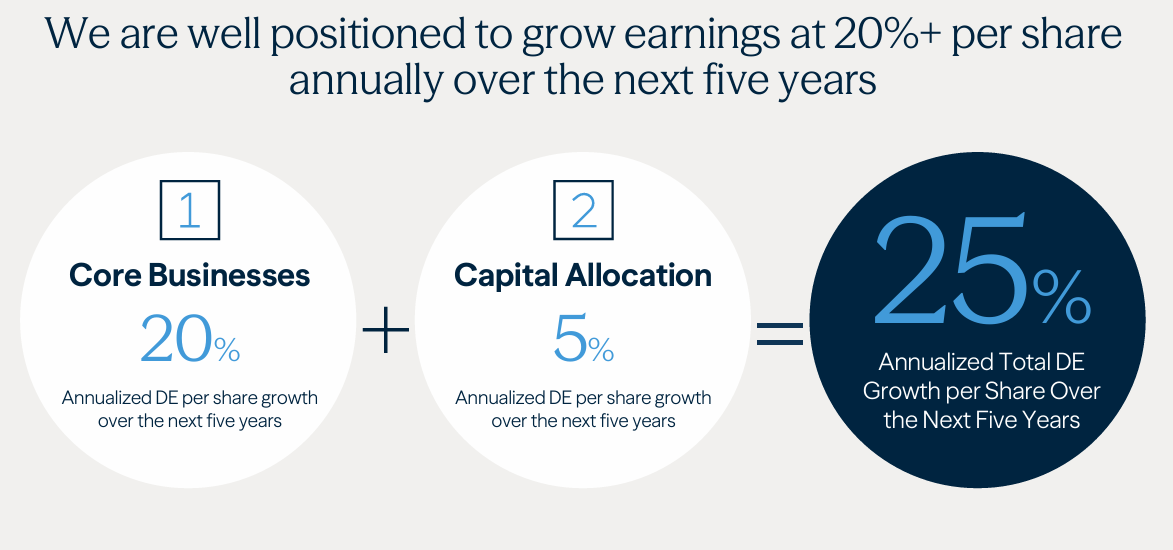
Hopefully some of the above is useful. I think this is a phenomenal business with phenomenal tailwinds. BN’s 5-year plan calls for just under $7 of distributable earnings per share in 2030. Historically they have roughly hit their 5-year targets. The stock is at $45 today. If they deliver $7 in DEPS I don’t think it will stay there. I hope to own BN for another 17 years and expect to be very happy with the outcome.
Nice article - thank you. Do you have thoughts on the current Private Equity narrative and sliding valuations and how it relates to Brookfield? Also thoughts on holding asset light BAM vs BN?