
About this blog: I have been investing for 25 years, professionally and personally. I look for stocks that have a high probability of compounding at 15% for at least 5 years with limited downside. I write these stocks up on my blog. You can find more about me, my philosophy, my mental models, and my portfolio structure on my site.
Key takeaways
Brookfield Asset Management (BAM) is the best bit of Brookfield Corporation (BN). It is asset light and fast growing with a high dividend yield and deep moats.
My highlights from the September 2026 investor day include:
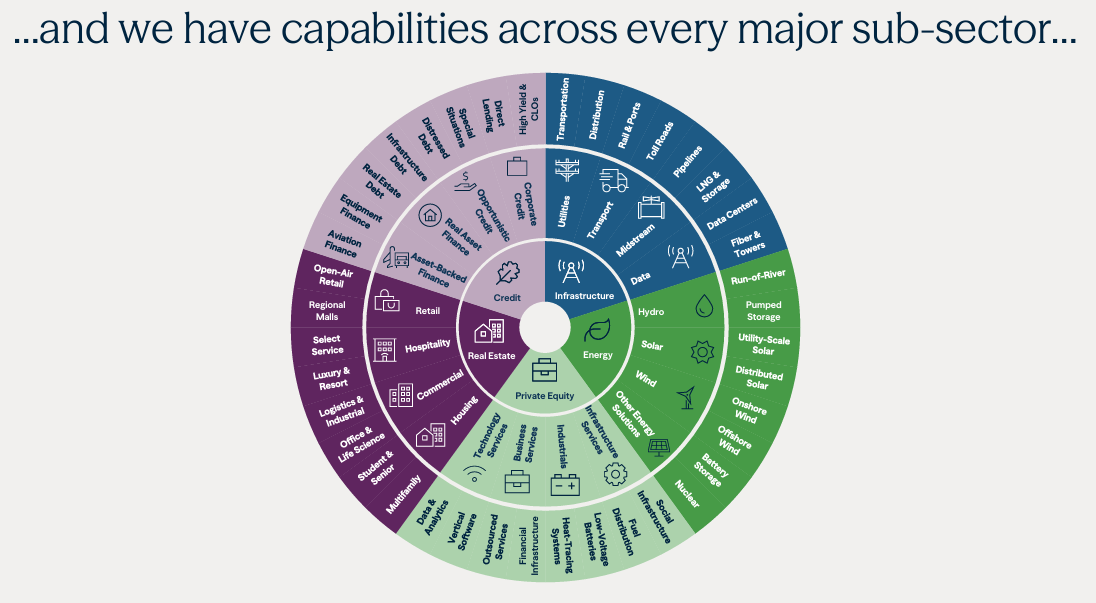
The breadth of product offerings by region, type, and point in the cycle: BAM has something to offer everyone, all the time (more or less!).
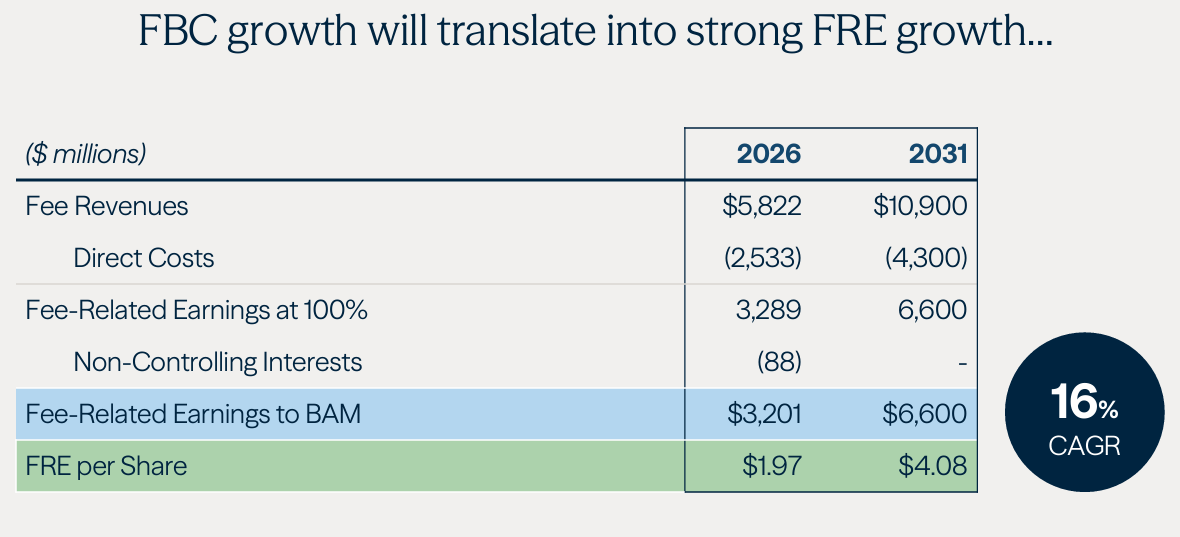
Growth. Over the next 5 years fee bearing capital is forecast to compound at 14%, fee related earnings at 16%, and distributable earnings (which includes carry) at 18%. On top of that BAM has several pathways to get growth over 20%, and pays a 4.5% dividend.
Carry “is actually happening now”, and carry elegible capital is forecast to grow much faster than fee bearing capital, at 24%. This means the embedded carry option is getting more valuable.
Detailed investor day notes
Most exciting time in the history of Brookfield: aim to double every 5 years or less but also “we are continuously enhancing the resiliency and stability of our underlying earnings”.
Diversified and “able to drive fundraising, investment performance and earnings quarter after quarter, year after year, cycle after cycle”.
Diverse across geographies, investment capabilities, products and investors, with “an ongoing process to ensure we go from strength to more strength in this regard”.
5 leading investment platforms (infra, energy, PE, RE, and credit) none of which is more than 1/3rd of revenues.
Non-flagship revenue is now the majority in all 5 platforms.
Have increased the institutional investor base 8x in 10 years, and the average has 2.5 products up from 1.9, which is significant given the denominator is growing so fast.
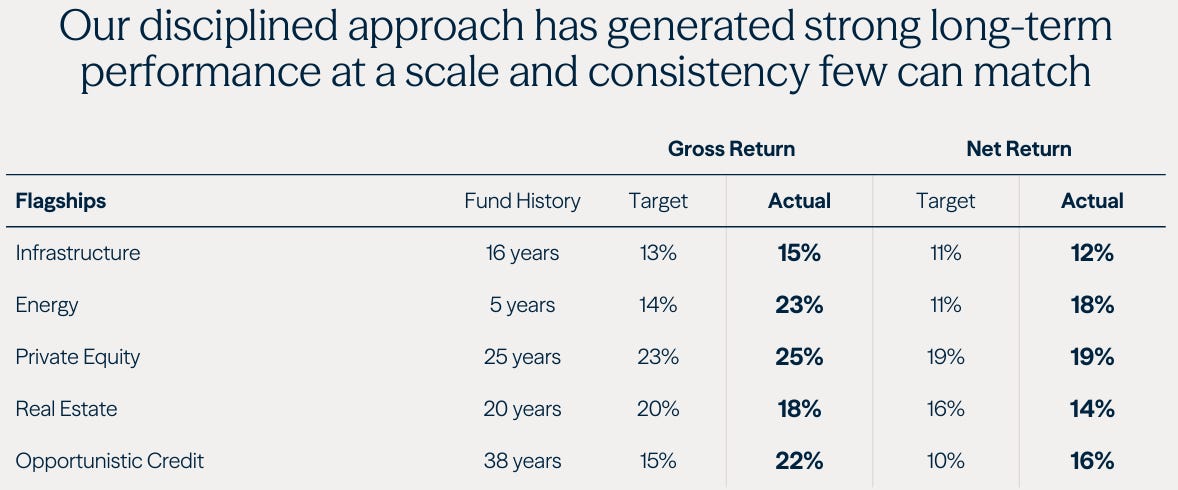
“We are delivering some of the best investment performance in our history to our LP partners.”
Fundraising: “Every business at Brookfield is printing records right now.”
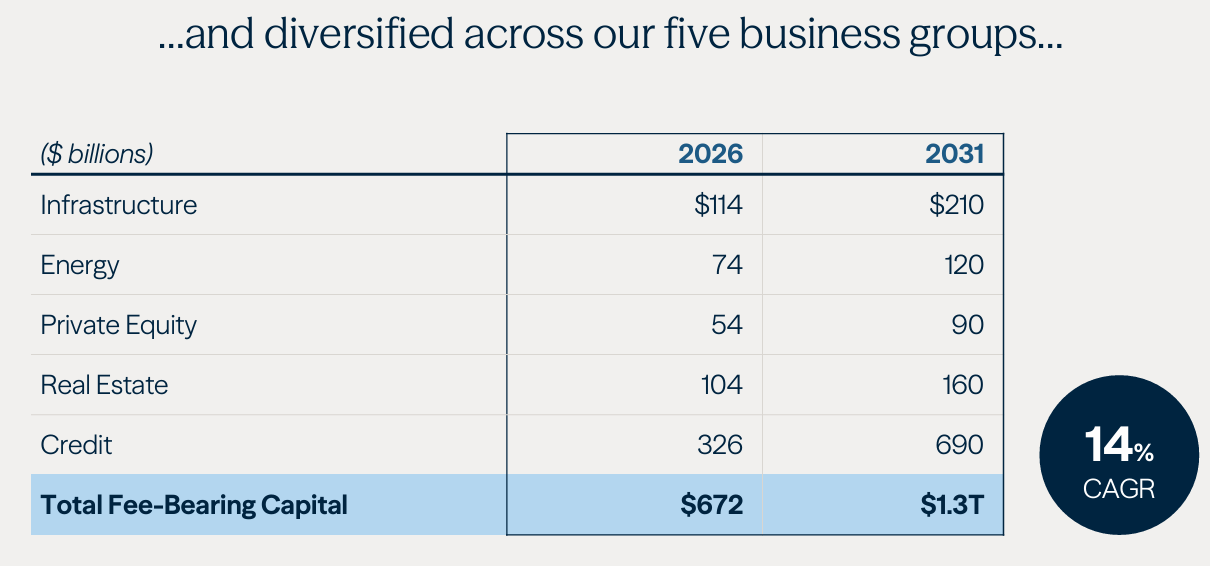
Fee bearing capital and fee related earnings have compounded at 16% since 2020. Over the next 5 years, FBC should grow 14%, FRE 16%, and DE 18%, with optionality on >20%. Targets:
$1.3tn of FBC by 2031, 14% CAGR.
Flagships will raise 35% more in the next 5 years than the last.
Complementary strategies will raise 90% more, two-thirds of it into mature strategies that have had 3-4 vintages.
BWS FBC will go from $150bn to $360bn, paying 25bps plus additional fees on assets allocated into private funds which will go from 6% to 18%.
Private Wealth FBC will grow 5x to $75bn.
FRE to $4.08 per share, 16% CAGR on FBC growth and operating leverage. Within this:
Revenue / FBC holds roughly stable, going from 8.6bps to 8.4bps.
FRE margins go from 55% to 60%.
Capital markets revenue grows from $50-100m revenue next year to $250bn in 2031 (this is fees on issuing debt across the ecosystem).
Realised carry compounds at 32%. Carry is “actually happening now”.
$9bn over the next 5 years of which $3bn goes to BN, $3bn to employees, and $3bn to BAM.
$35bn in the 5 years after that, 1/3rd of which is net to BAM.
Carry eligible capital compounds at 24% from $187bn today to $550bn.
DE to $3.99 per share, 18% CAGR. (DE is after SBC, carry, interest, and tax.)
On top of that, the defined contribution market, new complementary strategies, existing partner managers, and M&A “give us multiple paths to 20-plus percent annualized earnings growth” - e.g. can add $350m FRE by 2031 by exercising options in partner managers for $4bn.
Returns and the pros and cons of scale
“The returns have gotten better almost in every business…when you have larger sums of money, you buy better things with better people and better counterparties deal with you.”
“We have as much deal flow as anyone in the world. And therefore, we never feel we have to stretch to do a deal in order to deploy capital.”
Fundraising notes
401k is a massive opportunity. Working to be the default real asset provider for the most important plan administrators, like AllianceBernstein.
Private wealth/igh net worth is growing 30-35%.
Compute is becoming a (huge) asset class - i.e. financing chips as well as buildings. NVIDIA leading this and Brookfield are “one of the specialists of taking assets and figuring out what’s the right capital structure and placing it into the right capital market, whether it’s private or public.”
Investor Solutions Group is 2 years old.
Chaired by Howard Marks
Works with an investor to understand their specific needs: risk tolerance, return target, duration, cash yield, liquidity.
Creates a multi-product, multi-asset solution from among the Brookfield’s 65 products.
Has won $10bn of unique mandates, including $1bn on a 25 year lockup (which will compound to $20bn).
PE fundraising is tough.
60% of PE allocations over the last 15 years went to tech. Another 20-30% consumer and healthcare. Investors now feel overallocated here, but underallocated to heavy asset services, and industrials, where Brookfield wins.
“I’d say we’re definitely going to have the biggest flagship we’ve ever had, and we’re definitely going to have the largest PE fundraising… [that we’ve ever had].
In infrastructure, almost 80% of fundraising is from re-ups.
Credit and Oaktree integration
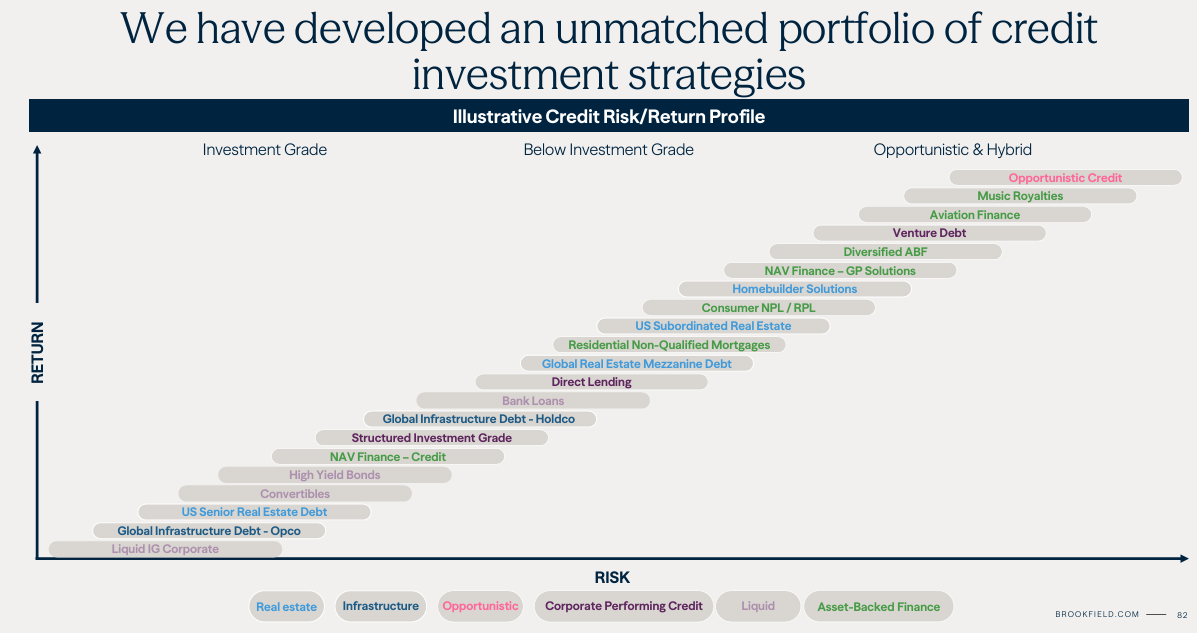
With Oaktree integrated, they manage $416bn in credit assets across 4 key verticals:
opportunistic, where the addressable market has expanded dramatically: the amount of sub-investment grade and BBB debt is up >4x since 2007, compounding at 2x global GDP.
real assets, i.e. real estate and infrastructure, where there is a huge funding gap.
asset-based finance, a $6tn market in the US ($20-30t globally) with only 8% private penetration.
performing corporate credit.
Products cover the full risk-reward spectrum.
3 areas of focus for the combined entity: client relationships (cross-selling); collaborating on sourcing and sharing knowledge; and new products.
Negative private credit headlines are narrowly focused on sponsor-driven direct lending and ignore the vast diversity of private credit.
Higher rates make it easier to raise capital in credit and interest rate volatility creates opportunities - part of BAM’s inherent diversification.
Real estate “is seeing a big flow of opportunity after the lows of 2023”.
“Real estate generally has huge pricing power today, which you didn’t have 5 years ago…rents are going up in everything.” “I think what we’re going to see across real estate…[is] the return of significant growth across almost every asset class”.
Real estate is wide open for complementary strategies - housing, logistics, luxury hospitality, triple net lease, and regional funds.
“[Rental] housing in the U.S. is probably one of our highest conviction views” since homeownership is so far out of reach for people.
Most competitors are small whereas Brookfield can offer investors scale solutions in everything from student to senior living and all the life stages in-between.
The median age of a first-time homebuyer 7 years ago was 33; today, it’s 40, so the US is becoming much more of a renter nation.
Home sales are down from 2.3m at the peak to 800k.
Liquidity is coming back; recent rate rises temper this a little, but when lease spreads are 50%, 25bps on rate doesn’t matter. “That’s probably the biggest difference from before”.
It is easy to exit 1) single assets where private capital is chasing and 2) unique, best-in-class assets.
It is not yet easy to exit the middle, i.e. “large portfolios of just assets” - this has been a buying opportunity.
Balance sheet investments
BAM is mostly capital light but uses the balance sheet to seed new complementary strategies and buy partner managers.
Generally target >20% returns.
Partner manager program creates more first-time entry points to Brookfield and more options they can offer to existing investors, and the market opportunity to do these transactions is growing rapidly. Will buy more partner-manager stakes when:
they can’t build it themselves or can’t build it fast enough to capture the opportunity;
it is value accretive, not just EPS accretive on day 1;
it has a commercial rationale, bringing something they don’t already have such as a capability, an LP base, an asset class expertise;
it will be more valuable as part of the Brookfield ecosystem, because the sellers are sophisticated and won’t see value otherwise; and when
there is alignment on principles and culture.
Other bits
Some of the renewable power projects started years ago are reaching FID now and are perfect for data centers - which makes them worth 3-5x underwriting.
1200 AI deployments in their companies are driving an uplift of $300m in ebitda, and it’s just early days stuff like predictive maintenance so far. “We buy businesses with 20% margins. We used to turn them in at 30% margins. Now we can turn in a 40% margin.”
Selected slide highlights
Breadth of fund offering:
Including in credit:
Historic returns:
Fee bearing capital diversification:
…and fee-related earnings growth (before carry):
Thanks for reading - if you enjoyed reading this please like and restack, and do get in touch if you have questions.
Pete
Disclaimer: This post is for informational and educational purposes only. Building Arks is not licensed or regulated to provide any financial advisory service and nothing published by Building Arks should be taken as a recommendation to buy or sell securities, relied upon as financial advice, or treated as individual investment advice designed to meet your personal financial needs. You are advised to discuss your personal investment needs and options with qualified financial advisers. Building Arks uses information sources believed to be reliable, but does not guarantee the accuracy of the information in this post. The opinions expressed in this post are those of the publisher and are subject to change without notice. The publisher may or may not hold positions in the securities discussed in this post and may purchase or sell such positions without notice.