
About this blog: I have been investing for 25 years, professionally and personally. I look for stocks that have a high probability of compounding at 15% for at least 5 years with limited downside. I write these stocks up on my blog. You can find more about me, my philosophy, my mental models, and my portfolio structure on my site.
Brookfield (BN) has its investor day on Thursday. This will be interesting, because the company’s preferred measure of earnings - distributable earnings, or DE - has grown significantly slower than expected recently. For example at the September 2025 Investor Day BN said they thought they could grow DE per share at 25% through 2030, but LTM growth has only been 6%. Granted some of DE is lumpy, making one-year measures less meaningful, but it is clear that either BN is not going to meet its guidance, or the next 4 years are going to be spectacular.
I have owned Brookfield almost continuously for 18 years, and in size for 8. My original review is here. I think the company has a slew of competitive advantages and some very attractive tailwinds for growth. I also think it is well managed by aligned people. I’m fairly settled on its being a permanent holding so long as the price is reasonable. Therefore, I don’t deep dive into every quarterly report.
However every now and again I do review it thoroughly, and over the next few months I hope to review each part of the empire. This is the first of those articles. It reframes BN’s Plan Value to help us understand what needs to happen for the stock to work.
Plan Value
BN’s Plan Value is a sum of the parts. I like it because it’s easy to understand, the methodology is broadly sensible, and it feeds into management incentives.
The company’s goal is to grow Plan Value by 15% plus per year. The stock trades at a substantial discount to Plan Value, so if they achieve their goal it will be a very good investment.
Plan Value is published in the quarterly supplemental and looks like this:
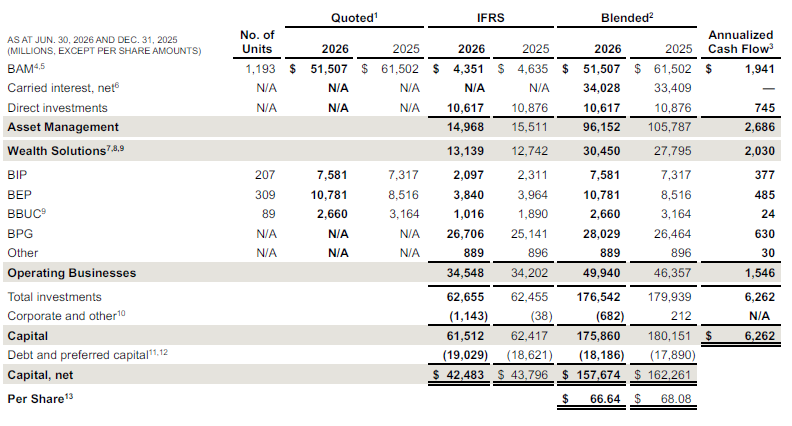
Of these:
BAM, BIP, BEP, and BBUC - the asset management, infrastructure, energy, and private equity companies, respectively - are separately quoted and are carried at market.
Carried interest is the present value of the future carry that BN expects to earn on funds managed by BAM. It is calculated as unrealised carry + 10x target carry, where target carry is what BN would earn if each fund met its investment targets.
Direct investments are investments that BN makes into funds managed by BAM, both to capture investment returns and to help BAM seed new funds.
Wealth Solutions (aka BWS) is an insurance company selling annuities, pension risk transfer, etc. BN value it at 15x distributable earnings, which comes out at about 2.3x IFRS book value.
Finally BPG is Brookfield Property Group, BN’s large on-balance sheet real estate operation which mainly owns offices and malls.
Restated Plan Value
I restate Plan Value in two ways. First, I group BPG with the real estate direct investments to show total exposure to that sector. And second, I group the remaining direct investments and operating businesses into one line representing BN’s infrastructure, energy, and private equity holdings, which are individually fairly small.
I think this gives a clearer idea of where BN’s capital is actually allocated as of June 30, 2026: