
Background
I reviewed Helios Fairfax Partners in June (link below). After a bit of chasing, I managed to get a call with management in July. It was a slightly frustrating call, because although they came across as honest and extremely competent, they were very careful not to say anything that isn’t already in the public domain. With this in mind they asked to see these notes before I published them, but did not ask for any substantive changes.

Historic performance
When Fairfax Africa bought Helios in 2020, significant carry was expected from Helios II and III and was capitalised onto the balance sheet in the form of Topco Class A. This carry never materialised, so Topco A suffered substantial writedowns over the next several years, driving a significant reduction in book value per share.
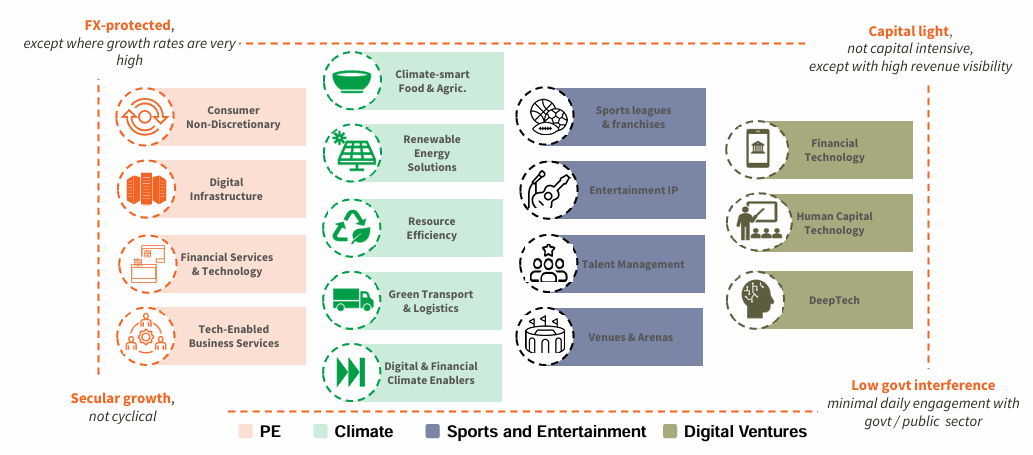
Part of the reason was that covid delayed exits. Carry pays out on profits over an 8% compounding hurdle, so the mere passing of time reduces carry, all else equal. However, another part of the reason was that some investments failed to perform. Management did not state this explicitly, but I infer it from the fact that the investment strategy changed significantly between Helios III and IV. From Helios IV onward, they target specific sectors (fintech, non-discretionary consumer, data centres, software) and have added guardrails around fx and dependence on government.
One output of this change in strategy is that they will no longer make hydrocarbon-related investments. There were a couple of oil and gas infrastructure investments in Helios II and III which I think went wrong, and probably contributed to the loss of carry. I believe these were also the assets that were meant to seed HETI, a potential permanent capital fund that Helios tried to launch a few years ago. Management confirmed that HETI won’t happen.
Importantly, the NPV of expected carry from Helios II and III was written down to zero. In addition, now that HFP has consolidated Helios (the manager), its value is no longer marked to market. Changes in expected future carry therefore no longer affect tangible book value.
Key takeaway: the lack of carry from Helios II and III wasn’t just a matter of time - it was also performance. As a result the investment criteria have been updated. Early evidence suggests that the new strategy is working – as of December 2025 the IRR for Helios IV was 23%.
Incidentally, there is a nice slide on the new strategy in the latest deck:
Fundraising and new fund launches
Fundraising for Helios V is on target. This is key for reducing cash bleed at Helios - more below.
CLEAR I, the climate fund, has closed at $250m and is now in deployment. This is a relatively small fund, which is normal for a first time fund, but if it works it becomes a second fund family with successively larger funds in the future: there is strong investor demand for sustainability in Africa. If standard timing applies, CLEAR II might launch 3-6y years after the final close of CLEAR I, meaning roughly 2029-2032.
Helios Sport and Entertainment Group achieved its first close in 1q26. However this was tiny, so Helios’ manager economics for the scaled platform will be decided in negotiations with clients and are still uncertain. They are not likely to be comparable to fund family economics since this is a permanent capital vehicle.
Helios Digital Ventures is also too young to disclose manager economics. However unlike HSEG it is a fund family structure, not permanent capital; I infer that if it scales, the economics might be comparable to the PE funds and CLEAR, which would be positive. Detailed performance information is not public but I note that HDV was marked up by a total of 8% in less than 4 months between the conversion of HFP’s loan into a partnership interest in March and the end of June.
Seven Rivers is the hedge fund strategy that was closed in 1q26. The commentary here was more positive than I expected. Performance was superb and given macro uncertainties (the Iran war, etc.) HFP wanted to cash in. However I get the feeling the strategy is still on the table and can use the historic track record to attract third party capital. No guarantees, but good if it happens.
Key takeaway: on balance this is better than I expected. Fundraising for Helios V is going well. I thought they were still fundraising for CLEAR I with a target of $400m, which was wrong. But I had also thought that Seven Rivers was dead and HDV might be struggling. In fact both are alive, if currently tiny in terms of third-party AUM.
Helios fee trends and getting to breakeven
As a reminder, Helios is the asset manager embedded in HFP.
The fee streams from Helios funds II and III were not material. This is important - these fee streams stopped in 1q26, so if they were material then getting to breakeven would have been harder.
Obviously HFP does not know when Helios will breakeven because it is dependent on the timing of fundraising. By my maths, which management have not seen or confirmed, an additional c.$800m of AUM is needed for breakeven on management fees alone (i.e. before consultancy fees and carry). Helios V is the only major fund in the market at the moment and is aiming for another $400m. If I’m right, an on-target close for Helios V would reduce losses before consultancy fees and carry to de-minimis levels. That would be very good news.
There is a caveat. When new money comes into a fund, fees are backdated to the fund close date. Catch-up fees are therefore recognised in the quarter when new money comes in. This will drive lumpiness in fee related earnings - some quarters may be profitable while others remain lossmaking.
Key takeaway: my work suggests that approximate breakeven for Helios is in sight, but growing it into a reliable profit generator might be a 3-5 year project.
Disclosure and investor relations
The intention is to continue to improve disclosure and communication. Obviously this takes time - figuring out what the market wants, and running proposed disclosures through legal, all while bedding in new employees and processes and actually running the business.
What won’t change much is disclosure on the underlying holdings in the funds. Overdoing this can compromise exit negotiations. However, it may be possible to give additional fund-level information without disclosing too much about individual holdings. Management did emphasise that there is effectively a “triple audit” on the fund holdings: external investors, fund audits, and the HFP audit all keep an eye on the valuations.
Key takeaway: I think disclosure and communication will improve, which can only help the stock price given the large discount to book value.
Co-investments
I was interested in how HFP selects and sizes co-investments, because under HFP’s investment sizing rules each of these can be up to 20% of assets (25% in some circumstances). The core criteria are that co-investments must have the potential to compound for longer than the PE fund cycle and pay dividends. Otherwise, it makes more sense to hold them in the funds.
Understandably management could not comment on the ongoing bid for CAB Payments, but I think it is interesting that they are prepared to commit significant capital (up to $75m) to a business that they have known well for years – CAB is a holding in Helios III. By my maths if the bid succeeds CAB will be around 15% of total assets.
Key takeaway: HFP is building two cash flow streams, not one; profits from Helios and dividends from co-investments. I think this increases the probability of HFP achieving its target of growing book value at 15% per annum and paying a dividend.
Alignment
I wondered why the SLP interest in Helios IV is so big on HFP’s balance sheet. Turns out it isn’t. The SLP interests are held through subsidiary companies which HFP consolidates. The Helios investment team also invest, sometimes with leverage which is recourse to the individuals. In the case of Helios IV these investments are significant, creating both an asset and a liability on HFP’s balance sheet, but the net exposure is in-line with a typical GP commitment.
Key takeaway: in at least some cases, Helios investment professionals have downside exposure to fund investments (as a result of the leverage) as well as upside exposure (via carry). I like that alignment.
Conclusions
NB management have not seen or commented on this section - it is entirely my opinion.
This call, combined with the 2q results, made me incrementally bullish on Helios Fairfax. The stock trades at a huge discount to book, which is growing. The IPO of Trone at roughly 2x carrying value gives some comfort that valuations are conservative. I have a clearer understanding of the AUM buildup needed to get Helios to profitability: progress will be lumpy, but I think an on-target close for Helios V gets us most of the way there, and then larger funds and progress with HSEG and HDV complete the job. (In fact, if you include consulting fees and carry, I suspect an on-target close for Helios V does the job, but those fee streams are unpredictable and it won’t immediately be apparent.) Finally, I think that communication will continue to improve. I think that all adds up to significant return potential over my 5-year time horizon.
Thanks for reading. If you have enjoyed this, please like and restack!
Pete
Disclaimer: This post is for informational and educational purposes only. Building Arks is not licensed or regulated to provide any financial advisory service and nothing published by Building Arks should be taken as a recommendation to buy or sell securities, relied upon as financial advice, or treated as individual investment advice designed to meet your personal financial needs. You are advised to discuss your personal investment needs and options with qualified financial advisers. Building Arks uses information sources believed to be reliable, but does not guarantee the accuracy of the information in this post. The opinions expressed in this post are those of the publisher and are subject to change without notice. The publisher may or may not hold positions in the securities discussed in this post and may purchase or sell such positions without notice.
Thanks - very interesting, and I must reread properly. I was fascinated by the 'Frontier' a while ago, and it never really came to anything. On reflection, it was partly due to the lack of depth in the markets - the choice wasn't much more than over-priced Consumer subsidiaries. I met a guy at a conference once, who was talking his own book, but said the only way to invest in Africa was through Private investments. So this makes sense as a way to access it, without needing a big ticket. Cheers.