
About this blog: I have been investing for 25 years, professionally and personally. I look for stocks that have a high probability of compounding at 15% for at least 5 years with limited downside. I write these stocks up on my blog. You can find more about me, my philosophy, my mental models, and my portfolio structure on my site.
When I reviewed Howard Hughes in May I published a sum of the parts. Shortly after that, the company updated their own SOTP and provided some new metrics. I’ve therefore updated mine. Here it is:
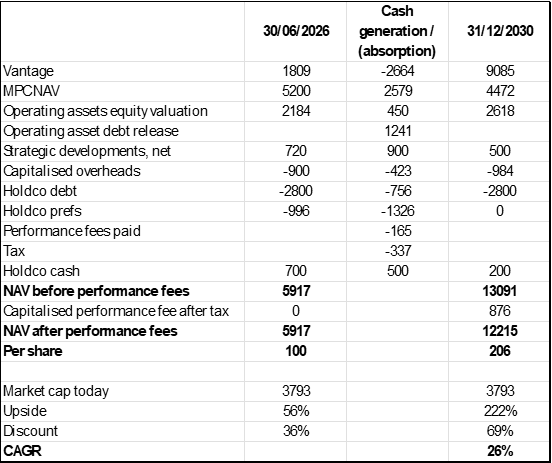
Here’s the logic.
Vantage - the new insurance arm
Vantage’s book value is currently $1.8bn. I value it at 1x today because its underwriting capabilities are unproven and it is growing rapidly into a soft underwriting market - a combination that could potentially cause trouble. However, given the quality of the new senior leadership team I assume it will prove itself, compound book value at 15%, and command a 1.5x multiple in 2030.
In addition, by my maths, HHH could contribute up to $2.7bn of excess real estate cash flow into Vantage, and they have said this is their top capital allocation priority. Once in Vantage, I assume this cash is immediately valued at 1.5x because it will both be invested into common stocks and be used as the equity backing for insurance policies. This ought to generate a total ROE of >15% and justify a 1.5x valuation. This - converting $1 into $1.5 overnight - is valuation alchemy, and it depends on Vantage scaling a profitable insurance operation; but that alchemy is exactly why HHH wants to pour capital into Vantage.
The combination of compounding book value at 15%, adding capital, and a 1.5x valuation adds up to a $9.1bn valuation for Vantage in 2030.
Master Planned Communities
This division gets a new metric: Residual Value. This is expected sales price per acres x available acres. I have mixed feelings about this. The whole point of MPCs is that to command strong prices, the acres need to be rationed. They can’t all be sold at once, so price x acres overstates liquidation value. Ideally, the land should be valued by discounting future profits. However, there is a strong argument that the likely growth in land prices, if the acres are appropriately rationed, is roughly equal to the appropriate discount rate: both are in the mid-to-high single digits. This means that discounting doesn’t make much difference.
For that reason, I am happy to use HHH’s published after-tax NAV. As of 1q26 this was $5.2bn. (Annoyingly, having introduced this metric in 1q26, they did not publish an updated figure again in 2q26 - instead they published the pre-tax version. This is a trend with HHH - they keep slicing and dicing the NAV in different ways, and can’t seem to consistently disclose the same metrics. I hope this changes.)
(Incidentally, Alexander Steinberg Investments disagrees that the Residual Value methodology is problematic. He argues that we use unit x price to value Buffet’s net worth, so why not MPC land? I disagree - Berkshire stock is far more liquid than MPC land, and its value does not depend on rationing to anything like the same extent. I think Buffett could dispose of his 15% stake over the course of, say, a year without moving the price much. HHH could not to do the same with its MPC land. Nonetheless, Alexander’s piece is well worth a read.)
Between now and 2030, the MPCs are going to produce a lot of cash. The company guides to $2.5-3bn of excess FCF from the real estate division after G&A and interest. I use the midpoint of this range, estimate cash flows from Operating Assets and Strategic Developments, and assume MPC produces the rest. This comes to $2.6bn - in effect the other real estate divisions cover G&A and interest.
Finally, for the 2030 valuation, I assume the Residual Value grows by 7% per year and deduct the cash produced.
Operating Assets
This division, which leases owned offices, commercial real estate, and multifamily assets, also has a new metric: Adjusted Maintenance Free Cash Flow. Unlike the previously-disclosed NOI, this accounts for financing and maintenance costs and the company says it is a good proxy for cash they can actually extract. The 1q26 deck suggests AMFCF will be $110m in 2026 and that peers command a 20x multiple. As a cross-check, the implied cap rate on historic NOI is 5.75%. This seems broadly fair to me - these are durable inflation-linked assets, NOI is growing at 6%, AMFCF grows faster due to inherent leverage, and HHH owns the land on which potential competitors could be built.
Although AMFCF is a useful disclosure, I’m sticking with NOI/cap rate as my valuation methodology for three reasons. First, it’s the industry standard. Second, HHH have previously given guidance for NOI from existing assets once they are mature, but they haven’t done this for AMFCF, so it is easier to calculate future value with NOI. Third, I think these assets can take on more debt as they stabilise, and it’s easier to calculate this using an NOI-based EV valuation metric than an AMFCF-based equity one.
What the AMFCF disclosure does do is give me the confidence to use a lower 5.75% for today’s valuation (producing a similar equity valuation to the company’s AMFCF one) and to 5.5% in 2030 (because I think stabilised assets are worth more). This produces a $2.2bn valuation today and a $2.6bn valuation in 2030 after the extraction of $1.2bn in cash for a LTV at 60%. I also model Operating Assets producing $100m AMFCF per year, roughly the current level.
Strategic Developments
This division, which mainly develops condos in Hawaii, gets another new metric: the after tax value of condos in construction and pre-development, all of which will be delivered by yearend 2030. Discounted at 10%, this value was $0.8bn as of 1q26 and approximately 10% of this was delivered in 2q26 so I value the residual at $720m today. Undiscounted, the value is $1bn; at 90% left to go, I think we can assume the division generates $900m of cash through 2030. And finally, I assume the company is able to permit future developments as previously disclosed, so that the remaining value in 2030 is $500 (the company leaves this out of their 2030 valuation).
Other items
G&A. I capitalise ongoing G&A plus the Pershing Square base fee at 10x for a $900m value today and I grow this at 2% per year for $1bn in 2030 - the company has previously said G&A should stabilise as the MPCs mature. This doesn’t include restructuring and deal costs but these ought to be fairly low now that Vantage has closed.
Tax is minimal because most of the assets are valued after tax and the taxable cash flows are mostly shielded by G&A, the Pershing fee, and interest.
Debt, prefs, and cash. I keep holdco debt flat at $2.8bn. I assume the company repays the preferred shares it issued to buy Vantage over 3 years, with the balance compounding in line with Vantage’s book value at 15%, for a total cash outflow of $1.3bn. I assume HHH deploys $500m of its currently $700m in holdco cash, leaving it with $200m in 2030.
Performance fees. I assume HHH trades at an average share price of $100 through 2030. This drives a cash outflow of $165m: Pershing Square gets 1.5% of the share price less $66, multiplied by a fixed 59.4m share count.
The share price is currently below $66, so HHH is not paying a performance fee. But for the 2030 NAV, I also capitalise the after-tax performance fee at 10x, assuming the stock trades at 90% of the NAV before performance fees are deducted. This is a bit clunky but it avoids circular formulae and is “good enough”.
How my valuation compares to the company’s
My 2030 valuation is very similar to the company’s despite several largely offsetting differences. Here are the major ones:
I assume Vantage is valued at 1x book today and 1.5x in the future, not 2x.
I assume that all excess cash flow is injected into Vantage rather than sitting on the holdco balance sheet. This includes $1.2bn of additional debt is taken on in the Operating Asset division, which the company does not model, with the result that their model shows the Operating Assets LTV declining to 42% vs. prior guidance of 60-65%.
I capitalise the performance fee paid to Pershing Square. HHH does not capitalise this, which I think is a major error.
Conclusion
This is not a particularly conservative valuation, and it is not meant to be. It does require things mostly to go right - but I have no particular reason to expect them not to. More importantly, my work shows a remarkable potential 26% CAGR through 2030 - in other words, the current price leaves room for imperfect execution.
A few things give me some comfort on the risks. Two key ones are:
The majority of the value of the MPC business is in residential land, and nearly half the resi land the company had at its main assets in 2020 has already been sold. These are not immature MPCs: they are well into the monetisation phase.
The incoming management at Vantage, Marc Grandisson and David Gansberg, appear to be excellent and have experience of scaling disciplined underwriting operations at Arch.
Thanks for reading. If you have enjoyed this, please like and restack!
Pete
Disclaimer: This post is for informational and educational purposes only. Building Arks is not licensed or regulated to provide any financial advisory service and nothing published by Building Arks should be taken as a recommendation to buy or sell securities, relied upon as financial advice, or treated as individual investment advice designed to meet your personal financial needs. You are advised to discuss your personal investment needs and options with qualified financial advisers. Building Arks uses information sources believed to be reliable, but does not guarantee the accuracy of the information in this post. The opinions expressed in this post are those of the publisher and are subject to change without notice. The publisher may or may not hold positions in the securities discussed in this post and may purchase or sell such positions without notice.
I really appreciate your work here. I put a meaningful chunk of our portfolio in HHH after the Vantage deal closed and the future path to compounding became obvious. You and Alexander have both independently led credence to how I was seeing it unfold.
I also do not understand $700M cash at the Holdco level. Are you combining it with HHC cash?