
About this blog: I have been investing for 25 years, professionally and personally. I look for stocks that have a high probability of compounding at 15% for at least 5 years with limited downside. I write these stocks up on my blog. You can find more about me, my philosophy, my mental models, and my portfolio structure on my site.
IRSA is an Argentine real estate company. I reviewed it in January and results since then have been strong. In this note, I revisit the bull case valuation.
The bull case rests on the idea that Javier Milei’s reforms might normalise the Argentine economy. By normalise I mean, amongst other things, that GDP might grow at 4-5% in real terms and inflation might decline from 25% now to 5-10%. In other words, Argentina might look like a normal emerging market rather than Peronist nightmare.
If that happens, I think IRSA could produce nearly 30% compounded returns to investors over the next 10 years. The figures below are in millions of dollars:
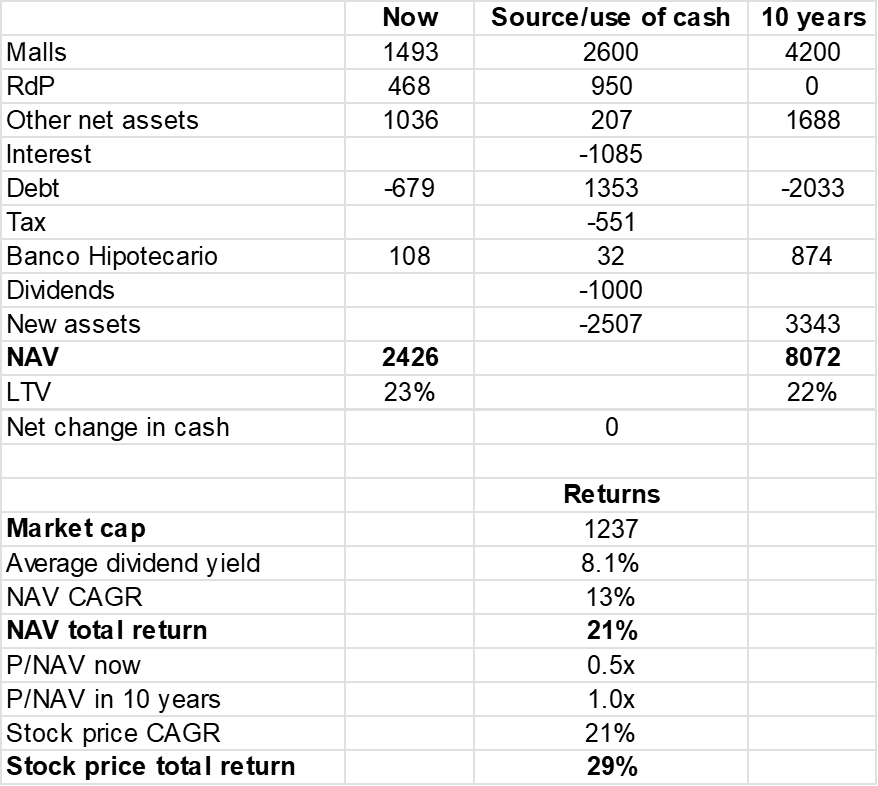
Let’s walk through the assumptions. Remember, this is a 10-year forecast:
Mall ebitda grows in-line with nominal dollar GDP, which I assume to be 7-8%. Argentina is emerging from a Peronist hyperinflation; its potential under sensible government is enormous, even before you consider that it is only just starting to monetise the enormous Vaca Muerta oil and gas field. 4-5% real GDP growth is very achievable. That should drive considerable wealth creation and consumption growth. Malls are underbuilt in Argentina and IRSA dominates the industry, so I am confident that it can convert nominal GDP growth into mall ebitda.
The multiple IRSA uses to value its malls rises from 8.5x ebitda currently to 12x as the cost of capital in Argentina falls. For comparison, US mall companies trade at 20x ebitda, despite weaker competitive positions and slower growth.
Ramblas del Plata (RdP), IRSA’s huge development project in prime Buenos Aires, produces $950m in cash. RdP is progressing strongly and IRSA is developing it in a capital light, low risk way.
IRSA’s other net assets - its land bank, offices, and hotels, less its liabilities except for deferred tax and debt - produce a 2% cash yield and increase 5% per year in nominal dollars, less than GDP.
IRSA issues additional debt worth 50% of the increase in mall valuations and pays 8% on its debt, similar to today.
Banco Hipotecario, the mortgage lender in which IRSA has a 30% stake, compounds book value at 15% per year in dollars and trades at 2x book - reasonable considering that Argentine mortgage debt/GDP is currently 0.5%.
IRSA pays $1bn in dividends, equal to an 8% yield on today’s share price, slightly lower than the annual dividend just announced.
IRSA reinvests all its remaining cash flows into building new assets. It funds these with 100% equity, builds them at an 8% yield on cost, and values them at a 6% cap rate. It completes all of these assets in year 10 so they do not contribute to operating cash flow before then.
Because the new assets are 100% equity funded, IRSA’s overall LTV does not rise (although it easily could).
I don’t think the operating assumptions above are aggressive if the Argentine economy normalises. Two things do deserve highlighting, however:
I exclude deferred tax from the NAV, because these are only payable on sale and IRSA does not intend to sell.
I assume the stock rerates from 0.5x NAV to 1x NAV.
Taken together, these two assumptions could be aggressive: in effect, I’m assuming that the stock trades a bit above book value. However, both assumptions are perfectly justifiable economically, and in my experience stock valuations can change in exactly these sorts of ways in sustained bull markets.
I think this exercise highlights the optionality embedded in IRSA at the current valuation. Remember, this is the bull case. It’s dependant on Milei’s reforms working and being sustained. I think there is a decent chance of that, but it is not guaranteed. However, as laid out in my original review, I do not see a lot of downside in IRSA unless the country returns to the worst of its Peronist past, which for its own case I very much hope it does not.
In short, I like the risk/reward in IRSA, and I am being paid 8-10% to wait.
Thanks for reading - if you enjoyed reading this please like and restack, and do get in touch if you have questions.
Pete
Disclaimer: This post is for informational and educational purposes only. Building Arks is not licensed or regulated to provide any financial advisory service and nothing published by Building Arks should be taken as a recommendation to buy or sell securities, relied upon as financial advice, or treated as individual investment advice designed to meet your personal financial needs. You are advised to discuss your personal investment needs and options with qualified financial advisers. Building Arks uses information sources believed to be reliable, but does not guarantee the accuracy of the information in this post. The opinions expressed in this post are those of the publisher and are subject to change without notice. The publisher may or may not hold positions in the securities discussed in this post and may purchase or sell such positions without notice.